
chapter 1
Introduction
A microcontroller is a compact, single-chip computer that contains a processor, memory, and input/output peripherals, designed to control specific functions. An embedded system is a complete, often smaller, electronic system that uses a microcontroller (or microprocessor) as its "brain" to perform a dedicated task within a larger device. In essence, the microcontroller is the core component within the broader embedded system, which includes other parts like sensors, actuators, and software tailored for a particular application.
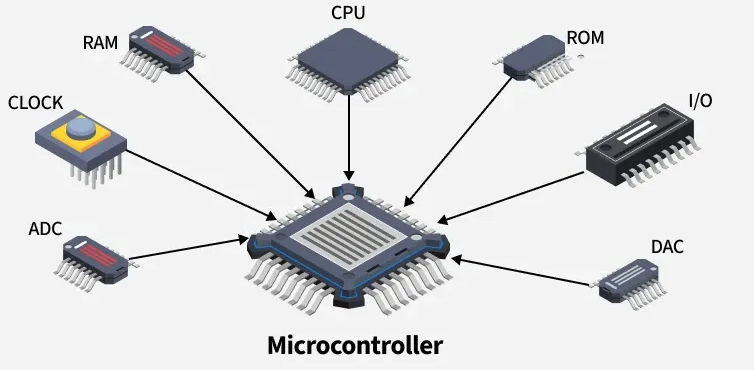
Microcontroller (MCU)
- What it is: A single, self-contained integrated circuit that includes a CPU, memory (RAM and ROM), and input/output (I/O) ports on one chip.
- Purpose: To perform specific control operations within a larger system.
- Key characteristics: Low-power consumption, cost-effective, and designed for dedicated tasks.
- Examples: Found in everyday devices like car engine control systems, medical devices, home appliances, and vending machines.
Embedded System
What it is:
A complete computer system that is part of a larger electronic or mechanical system. It's a computer embedded into another device to perform a specific function.
Components:
A microcontroller or microprocessor, application-specific firmware (software), sensors, actuators, communication interfaces, and a power supply.
Purpose:
To perform a particular task, rather than serving as a general-purpose computer.
Examples:
A smart thermostat, a fitness tracker, a washing machine's control panel, or a robot's operating system.
The Relationship
The microcontroller is the "brain" or the central processing unit within most embedded systems.
The embedded system is the entire package that includes the microcontroller, along with the necessary hardware, software, and peripherals to fulfill its intended function.
You cannot have a microcontroller-based embedded system without a microcontroller, but you could have an embedded system that uses a more complex microprocessor instead of a microcontroller.
Types of Microcontroller
The types of microcontroller are characterized by the bits, memory architecture, memory/devices and instruction set.
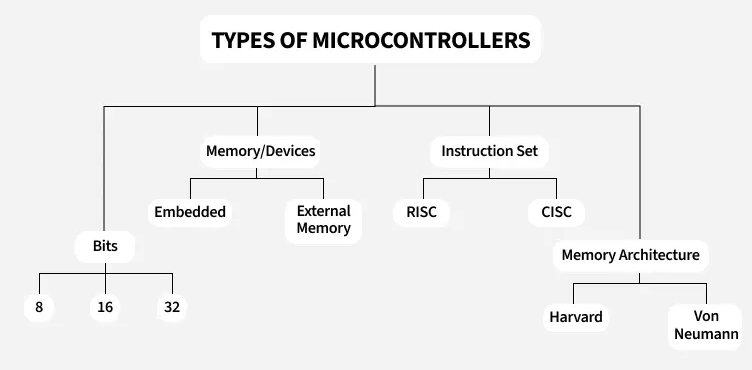
Classification of Microcontrollers by Number of Bits
8-bit Microcontrollers
- The internal bus is 8-bits wide.
- The ALU (Arithmetic Logic Unit) performs operations on 8 bits at a time.
- Example microcontrollers: Intel 8031/8051, PIC1x, Motorola MC68HC11.
16-bit Microcontrollers
-The internal bus is 16-bits wide, providing better precision and performance than 8-bit.
- A 16-bit microcontroller can handle a wider range of numbers (0x0000 to 0xFFFF, or 0 to 65535) compared to the 8-bit range (0x00 to 0xFF, or 0 to 255).
- Example microcontrollers: Extended 8051XA, PIC2x, Intel 8096, Motorola MC68HC12.
32-bit Microcontrollers
-These microcontrollers use 32-bit instructions for operations.
- Used in advanced applications like medical devices, engine control systems, office machines, and other embedded systems.
- Example microcontrollers: Intel/Atmel 251 family , PIC3x.
Classification of Microcontrollers by Memory Type
Embedded Memory Microcontroller
-All functional blocks are built into the chip.
- Includes program memory, data memory, I/O ports, serial communication, counters, timers, and interrupts.
- Example: 8051 microcontroller (has everything on the chip).
External Memory Microcontroller
-The microcontroller does not have all functional blocks on the chip.
- Some components, like program memory, need to be connected externally.
- Example: 8031 microcontroller (does not have program memory on the chip).
Classification of Microcontrollers by Instruction Set
CISC (Complex Instruction Set Computer)
-Allows complex instructions that can do multiple tasks in one command.
- Reduces the need for many simpler instructions.
- Example: CISC systems shorten execution time by reducing the number of instructions in a program.
RISC (Reduced Instruction Set Computer)
-Simplifies the instruction set, using fewer, simpler commands.
- Allows instructions to work on any register and access program and data simultaneously.
- Shortens execution time by reducing clock cycles per instruction.
- RISC systems generally offer better execution performance compared to CISC systems.
Classification of Microcontrollers by Memory Architecture
Harvard Memory Architecture Microcontroller
- Has separate memory for program and data.
- Allows simultaneous access to both program and data memory, improving efficiency.
- Common in microcontrollers that require faster data processing.
Von Neumann Memory Architecture Microcontroller
- Uses shared memory for both program and data.
- Simplifies design but can be slower since the program and data share the same bus.
- Shortens execution time by reducing clock cycles per instruction.
- RISC systems generally offer better execution performance compared to CISC systems.
Microcontroller Properties
- Microcontroller devices are capable of having words longer than 64 bits.
- Microcontroller consist of RAM , ROM , Timer , I/O Ports.
- Microcontroller ROM is used for program storage and RAM is used for data storage.
- It is designed by using CISC architecture.
- The power consumption of modern microcontrollers is significantly lower and have operating voltage range from 1.8V to 5.5V
- The latest feature of microcontroller is flash memory like EPROM and EEPROM.
- The most recent feature of a microcontroller is flash memory, such as EPROM and EEPROM.
Uses of Microcontroller
Microcontrollers are used in a wide range of electronic devices and systems given below:
Everyday Uses of Microcontrollers:
- Devices that detect and control light (like automatic street lights).
- Devices that monitor and adjust temperature (like smart thermostats).
- Fire detection and safety systems (like smoke alarms).
- Tools used in factories to measure and monitor things.
- Systems that control industrial processes automatically.
Uses of Microcontrollers in Industrial Control:
- Devices that measure and track industrial data.
- Systems that manage and control production processes.
Uses of Microcontrollers in Measuring Devices:
- Voltage meters.
- Devices that count rotating parts (like in motors).
- Current meters.
- Portable measuring tools (like digital multimeters).
https://www.geeksforgeeks.org/digital-logic/microcontroller-and-its-types/